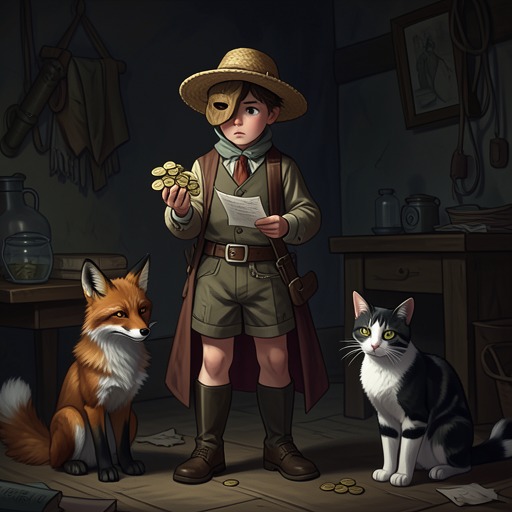
The Field of Wonders swindle and Pinocchio’s imprisonment
The Adventures of PinocchioThe Field of Wonders swindle and Pinocchio’s imprisonment is a linked episode in which a promise of effortless wealth draws Pinocchio into the scheme of the Fox and the Cat, and his attempt to seek justice ends with the victim behind bars. The four gold pieces he buries disappear; the court treats his complaint not as grounds to pursue the robbers but as a reason to imprison him. His release, like his arrest, follows a reversal of ordinary expectations: a public amnesty opens the prison doors, but he must claim to be a thief to be let out.
The Promise of Easy Wealth
Pinocchio encounters the Fox and the Cat on his way home after receiving five gold pieces from Fire Eater. The Fox is lame and leans on the Cat, who is blind and lets the Fox guide him. Their apparent dependence on each other lends the pair an air of harmless companionship, but they quickly show that they know Pinocchio’s name and turn the meeting toward his money. The Fox asks whether he wants to double his gold pieces, then enlarges the promise: his five coins could become thousands.
The proposed method is presented as a practical set of instructions, not merely a wish. Outside the City of Simple Simons, the Fox says, there is a Field of Wonders where a buried gold piece will sprout overnight into a tree laden with coins. Pinocchio is told to dig, cover the coin, water the earth, add salt, and wait until morning. The specificity of the routine makes the fantastic claim sound actionable. The Fox even calculates that five coins would yield twenty-five hundred, giving Pinocchio a vivid sum to anticipate rather than a reason to question the premise.
The journey also shows how the swindle works through confidence and delay. The Fox, the Cat, and Pinocchio stop at the Inn of the Red Lobster, saying they will rest and set out again at midnight so they can reach the field by dawn. None is very hungry, yet the Fox and the Cat later leave without paying for supper. When Pinocchio asks about the bill, the innkeeper falsely explains that the pair considered it an honor to leave him with the payment. Pinocchio recognizes that this supposed honor would have been no offense to him, but the incident does not make him abandon his companions or their larger promise.
The Field and the Theft
On reaching the City of Simple Simons, Pinocchio sees a population of impoverished animals: hungry dogs, shivering sheep, chickens begging for wheat, butterflies that have sold their colors, and birds stripped of their feathers. Meanwhile, a beautiful coach passes through the crowd carrying a Fox, a Hawk, or a Vulture. This contrast supplies a grim setting for the promise of sudden riches. The field outside the city looks ordinary, but Pinocchio accepts the Fox’s instructions and treats it as the place where his fortune will grow.
By this point he has four gold pieces left to plant. He digs the hole, carefully buries them, and covers them with earth. Asked to fetch water from a nearby brook, he has no pail, so he takes off his shoe, fills it, and uses it to sprinkle the ground. The improvised water container makes his belief tangible: he follows each direction with care, adapting to the absence of a tool rather than questioning whether the promised transformation can happen at all. The Fox and the Cat refuse any reward for helping him, presenting themselves as content simply to have made him rich.
Pinocchio is told to wait, and the pair depart. When he returns to the spot, a Parrot reveals that the Fox and the Cat have come back while he was away in the city, taken the four buried coins, and run off. Pinocchio resists believing this account and digs furiously until the hole is as large as himself. The search confirms the loss: not one coin remains. The promised harvest has resolved into an empty patch of earth, and the elaborate planting ritual has served only to give the thieves time and concealment.
The Complaint That Becomes a Sentence
In desperation, Pinocchio goes to the courthouse and reports the robbery. He gives the Judge the robbers’ names and descriptions and asks for justice. The Judge, an aged Gorilla with a flowing white beard and gold-rimmed spectacles whose lenses are missing, listens with apparent patience and emotion. His sympathetic manner raises the expectation that Pinocchio’s account has been heard. Instead, he orders two large Mastiffs in Carabineer uniforms to take the complainant to prison because he has been robbed of four gold pieces.
The ruling reverses the ordinary roles of victim and offender. Pinocchio has come forward to identify the people who took his money, yet the court’s sentence falls on him, and the officers silence his protest by clapping their paws over his mouth as they hustle him away. The scene makes the consequences of the swindle more severe than the disappearance of his savings: even the institution he approaches for redress turns against him. His credulity has exposed him to fraud, but the account does not suggest that the court’s response is a fair or proportionate judgment.
Four Months in Prison and an Unexpected Release
Pinocchio remains in prison for four long months. His release does not come through an investigation, a confession by the Fox and the Cat, or a reversal of the Judge’s sentence. Instead, a young emperor wins a victory over an enemy and orders public celebrations, including the opening of all prison doors. When Pinocchio asks the Jailer to let him go with the other prisoners, the Jailer initially excludes him. Pinocchio then claims that he, too, is a thief. The Jailer accepts that classification as grounds for freedom, bows, removes his cap, and opens the door.
The escape from prison is therefore both a fortunate consequence of a general decree and a final irony in the episode. Pinocchio was jailed when he reported a theft, and he gets out by falsely placing himself among thieves. He runs away without looking back; the lost coins are not recovered, and the Fox and the Cat face no punishment in this episode.
Narrative Function
The episode puts the warning against promises of effortless wealth into a sequence of concrete choices and reversals. The Fox supplies a persuasive story and a repeatable procedure; Pinocchio follows it closely, even using his shoe when he lacks a pail. The Parrot’s disclosure and the empty hole then replace the imagined tree of coins with proof of the fraud. The lesson is reinforced elsewhere in the narrative when Pinocchio reflects that he should have listened to the Talking Cricket, but here the immediate cost is measured in four stolen coins and four months behind bars.
The narrator’s direct address to child readers elsewhere in the book gives the adventure a double edge: the danger is entertainingly extravagant, while its consequences press the reader to judge Pinocchio’s choices. Yet the episode does not reduce its world to a simple equation in which every misfortune is just punishment for foolishness. Pinocchio’s credulity helps the Fox and the Cat deceive him, but the court’s decision and the prison term deepen the injustice rather than correcting it. His release depends not on wiser judgment or earned reward but on an emperor’s celebration and a convenient change in how he describes himself.